
On Sunday September 3, Debbie, Annolies and Barry, ably supported by some enthusiastic children, demonstrated to interested parishioners how to establish and maintain a worm farm.
Together we set up 2 empty worm farms – one donated by Christabel and Linda for use at St Paul’s and one bought by the Meredith family for their personal use.
How to establish a worm farm
Line the bottom section with paper. Add soaked bedding material for the worms, such as coconut peat (often provided with the worm farm).
Add a layer of composting earthworms to the bedding. Provide them with limited food scraps to begin with, including crushed egg shells for essential calcium, (as the worm consume these scraps, you can add increasing amounts)
Add an insulation layer (the hessian that comes with the kit or a layer of damp newspaper).
Place the lid on the box.
Simple worm farming tips:
- feed worm small amounts of citrus, garlic, onion or chillis (too much makes the farm too acidic for the worms). The normal amount coming out of a family kitchen is just about right.
- Worms cope with cold weather better than hot weather. Shield them from the fierce summer sun in the shade of a tree, or on the south side of the house in the shade.
- Worms eat the equivalent of their own weight daily.
- When worms consume kitchen scraps, they convert them into nutrient-rich castings that are 10x more bioavailable for plants.
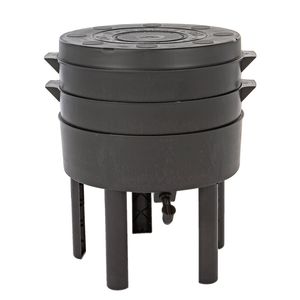
The above worm farm café can be obtained from Bunnings for $79 and City of Fremantle will provide a $40 rebate. They also sell some worm farms at a discounted rate https://compostrevolution.com.au/products/worm-farms/?gclid=CjwKCAjw6eWnBhAKEiwADpnw9mJTLx6lR2b8s0E7ec9aOLPkQMQkxqeRlPKyRAkFPAGKVcDXRbmYKhoCBmkQAvD_BwE